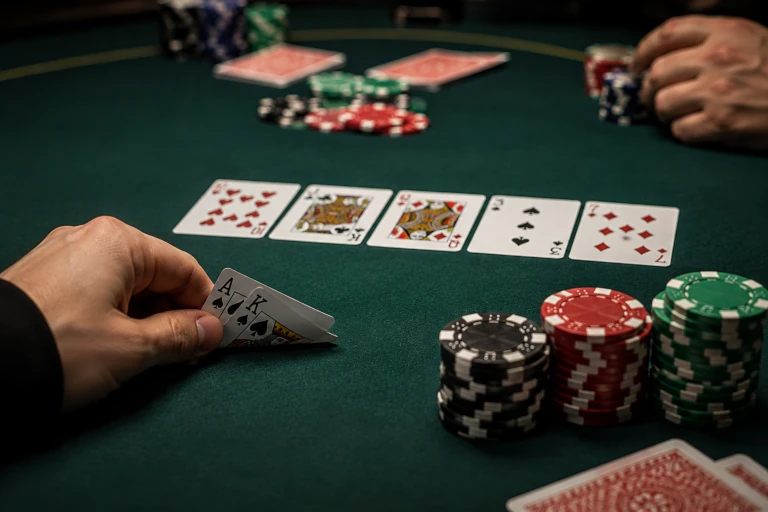
♠ What is No-Limit Texas Hold'em?
No-Limit Texas Hold'em is the world's most popular form of poker. Played in cash games and major tournament series like the World Series of Poker (WSOP), Hold'em is a strategic game of incomplete information. Each player is dealt two private hole cards, which they combine with five shared community cards to form the strongest possible five-card hand—or use tactical betting to force all opponents to fold.
Core Objective: Win chips by either holding the best five-card poker hand at Showdown or forcing every other player to fold their cards prior to Showdown by making uncalled bets and raises.
Cash Games vs. Multi-Table Tournaments (MTTs)
While the fundamental rules remain identical, cash games and tournaments demand distinct strategic approaches:
- Cash Games: Chips represent direct monetary value. Stack sizes remain deep (typically 100BB+), players can buy back in immediately if stacked, and blinds remain static indefinitely. The objective is to maximize Expected Value (+EV) in every individual spot.
- Multi-Table Tournaments (MTTs): Players pay a fixed buy-in for a starting tournament stack. Blinds and antes increase systematically over time to force action. Elimination is permanent (or limited in re-entry events). Strategic decisions are heavily dictated by tournament survival and the Independent Chip Model (ICM).
♠ Official Rules & Table Mechanics
ENFORCEABLE RULESNo-Limit Texas Hold'em is governed by strict, universal rules enforced in live cardrooms and online platforms globally.
1. Mandatory Betting Order
Rule: Action strictly follows a clockwise sequence around the table.
• Pre-Flop: The player directly to the left of the Big Blind acts first.
• Post-Flop (Flop, Turn, River): The first remaining active player to the left of the Dealer Button acts first.
2. Forced Bets (Blinds) & Dealer Button
Before cards are dealt, the Small Blind and Big Blind must be posted. The Dealer Button rotates clockwise by one position after every hand to ensure every player posts blinds equally over time.
3. Legal Bet & Raise Limits
Minimum Bet: Must equal or exceed the Big Blind size.
Minimum Raise: Must equal or exceed the size of the previous bet or raise in that round.
All-In Rule: A player may wager all remaining chips at any time. An all-in bet smaller than a full legal raise does not reopen betting to players who have already acted.
4. Showdown Mechanics
If two or more players remain active after the final betting round on the river, a Showdown occurs. The player who constructs the best five-card poker hand using any combination of their two hole cards and the five community cards wins the pot.
♦ Strategic Principles vs. Game Rules
STRATEGY & CHOICEWhile the rules dictate how you can legally play, strategy determines what decisions maximize your profit over time.
| Game Aspect | Official Enforceable Rule | Strategic Choice (Player Option) |
|---|---|---|
| Starting Cards | You must receive 2 hole cards face down. | You choose which cards to play or fold based on your position and range charts. |
| Bet Sizing | Bet must be between 1 BB and your full stack (All-In). | You select sizing (e.g., 25% pot vs 75% pot) to optimize value or fold equity. |
| Turn to Act | You must wait until action reaches you clockwise. | You choose whether to fold, call, or raise when it is your turn. |
| Showdown | The best 5-card combination wins the pot. | You decide whether to bet to force a fold or take a drawing hand to showdown. |
🏆 Official Poker Hand Rankings
Texas Hold'em evaluates hands strictly using standard five-card poker combinations. Hands are ranked from strongest to weakest as follows:
1. Royal Flush
Composition: A, K, Q, J, 10, all of the same suit.
The unbeatable, highest possible hand in Texas Hold'em.
2. Straight Flush
Composition: Five consecutive numerical cards of the exact same suit (e.g., 9♠ 8♠ 7♠ 6♠ 5♠).
Ties are broken by the highest-ranking card at the top of the sequence.
3. Four of a Kind (Quads)
Composition: Four cards of identical numerical rank, plus one side card or kicker (e.g., A♦ A♠ A♣ A♥ 7♣).
Higher-ranked matching quads beat lower quads.
4. Full House
Composition: Three cards of one rank combined with two cards of another rank (e.g., K♠ K♦ K♣ 10♠ 10♥).
The rank of the three-of-a-kind determines the winner in full house match-ups.
5. Flush
Composition: Any five cards of the same suit, regardless of sequential order (e.g., A♣ J♣ 8♣ 4♣ 2♣).
Ties are broken by comparing the highest individual card in the flush.
6. Straight
Composition: Five numerical cards in sequence of mixed suits (e.g., 8♦ 7♠ 6♣ 5♠ 4♦).
Aces can act as either high (A-K-Q-J-10) or low (5-4-3-2-A), but cannot wrap around (e.g., K-A-2-3-4 is invalid).
7. Three of a Kind (Set / Trips)
Composition: Three cards of identical numerical rank, plus two unrelated side kickers (e.g., Q♠ Q♦ Q♣ 9♥ 2♠).
Known as a "Set" when holding a pocket pair that hits a board card, or "Trips" when matching two board cards.
8. Two Pair
Composition: Two separate sets of matched pairs, plus one side kicker (e.g., J♠ J♦ 8♣ 8♥ A♠).
If two players hold Two Pair, the player with the highest single pair wins.
9. One Pair
Composition: Two cards of identical numerical rank, plus three side kickers (e.g., 10♠ 10♦ 6♠ 4♣ 3♥).
The most common winning hand in No-Limit Hold'em.
10. High Card
Composition: Five cards that fail to construct any of the above combinations.
Hands are evaluated solely by their highest individual card (Ace being highest).
🎯 Table Position Strategy
Position is the single most important tactical variable in No-Limit Hold'em. Position generally becomes stronger as you move closer to the dealer button because acting last allows you to see how your opponents act before making your own decision.
Positions Defined (Full Ring & 6-Max)
| Position Name | Abbreviation | Strategic Characteristics |
|---|---|---|
| Under the Gun | UTG | First to act pre-flop. Requires extremely tight, defensive starting hand ranges. |
| Middle Position | MP / HJ | Includes Middle Position and the Hijack. Range widens slightly as fewer players remain behind. |
| Cutoff | CO | Late position directly to the right of the button. Excellent position for steal-raising. |
| The Button | BTN | The premier position at the table. Guaranteed to act last on all post-flop streets. |
| Small Blind | SB | Out of position on all post-flop streets despite acting late pre-flop. Requires cautious play. |
| Big Blind | BB | Closes pre-flop action. Gets a discount to call raises but must play post-flop out of position. |
♦ Solver-Based Pre-Flop Opening Ranges
Mastering pre-flop starting hand selection prevents costly post-flop mistakes. The interactive grid below highlights standard solver-based (GTO-inspired) open-raise ranges for 100 Big Blind (100BB) cash games.
How to Read the Chart:
• Suited hands (s): Top-right section above the diagonal (e.g., AKs, JTs). Suited hands possess ~2.5% higher equity and far greater playability than offsuit counterparts.
• Offsuit hands (o): Bottom-left section below the diagonal (e.g., AKo, QJo).
• Pocket Pairs: Diagonal line running from AA down to 22.
📊 Bet Sizing Benchmark Guide
Proper bet sizing serves two purposes: extracting maximum value when holding strong hands, and applying maximum pressure when bluffing.
| Street / Scenario | Typical Solver Benchmark | Strategic Purpose |
|---|---|---|
| Pre-Flop Open Raise | 2.0× – 2.5× BB (Online) / 3.0× – 4.0× BB (Live) | Builds the pot while keeping risk controlled across a wide opening range. |
| In-Position 3-Bet | 3× Initial Open Raise | Denies equity to caller and builds a pot while holding positional advantage. |
| Out-of-Position 3-Bet | 4× – 4.5× Initial Open Raise | Larger size compensates for positional disadvantage on post-flop streets. |
| Flop Small C-Bet | 25% – 33% Pot | Applied on dry, static boards (e.g., A-K-4) to pressure weak ranges efficiently. |
| Flop Medium C-Bet | 50% – 66% Pot | Standard sizing on dynamic, connected board textures (e.g., 9-8-7). |
| Turn / River Overbet | 125% – 150%+ Pot | Polarized sizing used when holding strong nutted value hands or complete bluffs. |
♣ Pot Odds Calculator & Required Equity
Pot odds define the ratio between the current pot size and the cost of making a call. Comparing your required equity against your actual hand equity determines whether calling is profitable in the long run.
Mathematical Formula:
Required Equity = Call Amount ÷ (Total Pot Before Bet + Opponent Bet + Call Amount)
Worked Example: If the pot is $100 and your opponent bets $50, your cost to call is $50. Plugging values into the formula: $50 ÷ ($100 + $50 + $50) = $50 ÷ $200 = 25% Required Equity. If your drawing hand has more than 25% chance to hit, calling is mathematically profitable (+EV).
Outs & Equity Cheat Sheet
| Drawing Combination | Outs | Flop to River % (2 Cards) | Turn to River % (1 Card) |
|---|---|---|---|
| Flush Draw | 9 | 35.0% | 19.6% |
| Open-Ended Straight Draw (OESD) | 8 | 31.5% | 17.4% |
| Two Overcards (e.g., A-K vs 10-10) | 6 | ~24.0%* | 13.0% |
| Inside Straight (Gutshot) | 4 | 16.5% | 8.7% |
| Set to Full House or Quads | 7 | 33.4% | 15.2% |
*Note: Two overcard equities vary slightly (23%–25%) based on suit blockers.
The "Rule of 2 and 4" Mental Shortcut:
• On the Flop: Multiply your total outs by 4 to approximate your Flop-to-River winning percentage.
• On the Turn: Multiply your total outs by 2 to calculate your Turn-to-River winning percentage.
Note: This rule provides a fast mental approximation and becomes slightly less precise with massive 12+ out combo draws.
🧠 Advanced Concepts: EV, ICM & Range Dynamics
Moving from a beginner to an advanced player requires shifting away from thinking about individual hands toward thinking in terms of full ranges, expected values, and tournament risk models.
Expected Value (EV)
Expected Value (EV) measures the average mathematical outcome of a specific poker decision if repeated thousands of times. A play with a positive outcome is +EV, while a play that loses money over time is -EV. Advanced players routinely sacrifice short-term outcomes to execute +EV plays consistently.
Independent Chip Model (ICM)
In tournament poker, chips do not have a linear cash value. The first chip in your stack is worth more than the last chip. ICM (Independent Chip Model) calculates a player's actual cash equity in a tournament prize pool based on current stack sizes. ICM dictates that calling an all-in requires higher equity near tournament payout bubbles than during early tournament stages.
3-Betting & 4-Betting Mechanics
A 3-bet is the second pre-flop raise (Initial Open = 2-Bet, Re-Raise = 3-Bet). Modern strategy utilizes a Polarized Range (holding elite value hands like AA/KK/AK alongside light bluffs with high card removal like A5s/A4s) or a Linear Range (pure top-tier value hands and strong broadways) depending on position and opponent tendencies.
Continuation Betting (C-Betting) & Check-Raising
A C-Bet occurs when the pre-flop raiser bets on the flop. Effective C-Betting relies on board texture: high, dry boards (e.g., A-K-2) favor the pre-flop raiser's range advantage, justifying high C-Bet frequencies. Conversely, wet, connected boards (e.g., 8-7-6) favor the caller's range, requiring lower betting frequencies and defensive check-raising.
Implied Odds & Reverse Implied Odds
Implied Odds factor in the additional money you expect to win from your opponent on future betting streets after hitting a draw. Reverse Implied Odds describe the risk of hitting your draw but coming second-best (e.g., making a low flush against a higher flush draw), causing you to lose a massive pot.
💼 Bankroll Management & Variance
Proper bankroll management (BRM) ensures that natural mathematical variance never causes you to lose your poker funds. Never risk money you cannot afford to lose.
| Game Format | Recommended Minimum Bankroll | Variance Risk Level |
|---|---|---|
| No-Limit Cash Games | 30 – 50 Full Buy-ins (e.g., $3,000 for $100NL) | Moderate |
| Multi-Table Tournaments (MTTs) | 150 – 300 Tournament Buy-ins | Very High |
| Sit & Go's (SNGs) | 50 – 75 Tournament Buy-ins | Low to Moderate |
⚠️ 7 Critical Beginner Mistakes to Avoid
- Ignoring Bankroll Management: Playing at stakes too high for your bankroll leads to premature bankruptcy during inevitable downswings.
- Playing Too Many Starting Hands: Entering pots with weak, unsuited cards out of position bleeds chips rapidly.
- Calling Too Frequently ("Calling Station"): Passive play forces you to pay off value bets while failing to build pots when holding winning hands.
- Disregarding Table Position: Playing out of position forces you to make decisions with an information deficit on every street.
- Chasing Poor Draws Without Pot Odds: Calling bets with weak draws when pot odds do not justify the call is guaranteed -EV over time.
- Over-Bluffing at Low Stakes: Low-stakes recreational players call too often. Reserve complex bluffs for capable opponents who can fold.
- Playing on Tilt: Letting emotional frustration after a bad beat dictate your play results in reckless decisions.
📚 Extended Poker Terminology Glossary
Master the language of modern GTO solver theory and traditional poker jargon.
An unexploitable baseline strategy designed using mathematical algorithms that prevents opponents from gaining an EV edge over time.
Deviating intentionally from balanced GTO baselines to maximize profit against specific opponent strategic mistakes.
When one player's full distribution of hands holds higher overall mathematical equity on a given board texture than their opponent's range.
When a player's range contains a higher proportion of the strongest possible hand combinations (sets, straights, flushes) on a board.
Effective stack size divided by the pot size on the flop. Low SPR (< 3) commits players to hands much quicker than high SPR (> 10).
Holding specific cards in your hole cards that make it mathematically impossible or less likely for an opponent to hold a specific combination.
A betting range consisting strictly of very strong nutted value hands and complete bluffs, with no medium-strength hands.
A medium-strength hand that can only beat opponent bluffs and loses to all opponent value bets.
An unconventional bet made out of position into the pre-flop raiser before they have a chance to make a continuation bet.
A small bet placed out of position on the river intended to set a cheap price to see showdown and prevent a larger bet.
The percentage of a hand's theoretical equity that a player actually captures, heavily influenced by position and playability.
Checking after an out-of-position opponent checks, guaranteeing a free card or taking the hand directly to showdown.
❓ Frequently Asked Questions (FAQ)
What is the best starting hand in Texas Hold'em?
Pocket Aces (A♠ A♦) is the absolute best starting hand in Texas Hold'em. However, even Pocket Aces can lose to speculative hands if multiple opponents enter the pot, making pre-flop raises essential to isolate opponents.
What does "No-Limit" mean in poker?
"No-Limit" means there is no maximum restriction on the bet or raise size a player can make. On any legal turn to act, a player can bet all of their remaining chips (go "All-In").
How do pot odds work?
Pot odds compare the current size of the pot against the cost of making a call. If calling a $50 bet into a $150 pot requires $50, you are paying $50 to win a total pot of $250 (20% equity required). If your hand's chance of winning exceeds 20%, calling is profitable.
Is online poker legal in Canada?
Yes. Online poker is regulated at the provincial level in Canada. Ontario operates a fully regulated market with licensed private operators, while players in other provinces access licensed international rooms or provincial lottery poker platforms.
What is the difference between GTO and Exploitative strategy?
GTO (Game Theory Optimal) is a defensive, balanced strategy that prevents opponents from exploiting you. Exploitative strategy intentionally strays from balance to capitalize on specific mistakes made by weak or recreational opponents.
🍁 Regulated Online Poker Rooms in Canada
Secure platforms offering real-money No-Limit Hold'em cash games and tournaments for Canadian players.
GGPoker
Ontario & Rest of CanadaHigh tournament guarantees, integrated staking options, and massive global cash game traffic.
PokerStars
Ontario & Rest of CanadaIndustry-leading desktop client, smooth multi-tabling features, and deep tournament structures.
888poker
Check Local AvailabilityExcellent choice for recreational players featuring low-stakes cash tables and daily freeroll series.